

Annals of Computer Science and Intelligence Systems, Volume 47
Proceedings of the 21st Conference on Computer Science and Intelligence Systems (FedCSIS)
978-83-977088-2-2 (ART)
Main Track
Preface
Dear Reader, it is our pleasure to present to you the Proceedings of the 21th Conference on Computer Science and Intelligence Systems (FedCSIS 2026), which took place on 23-26 August 2026, in Riga, Latvia.
FedCSIS 2026 was chaired by Oksana Nikiforova. Moreover, Andrejs Romānovs was the Chair of the Organizing Committee.
This year, FedCSIS was organized by the Polish Information Processing Society (Mazovia Chapter), IEEE Poland Section Computer Society Chapter, Systems Research Institute Polish Academy of Sciences, The Faculty of Mathematics and Information Science of the Warsaw University of Technology, The Faculty of Electrical and Computer Engineering of the Rzeszów University of Technology, The Faculty of Electrical Engineering af the Riga Technical University, and The Faculty of Engineering and Management of the University of Technology and Arts in Applied Sciences.
FedCSIS 2026 was technically co-sponsored by the IEEE Poland Section, IEEE Serbia and Montenegro Section, IEEE Estonia Section, IEEE Latvia Section, IEEE Lithuania Section, IEEE South Africa Section, Serbia and Montenegro Section Computational Intelligence Society Chapter, IEEE Young Professionals Affinity Group, Novi Sad, Republic of Serbia, IEEE Romania Section WIE Affinity Group, Czechoslovakia Section Computer Society Chapter, Poland Section Computer Society (Gdańsk) Chapter, Estonia Section Computer Society Chapter, Latvia Section Computer Society Chapter and Lithuania Section Computer Society Chapter.
FedCSIS 2026 was sponsored by InfoSoftware Polska as well as MDPI Information, MDPI Electronics, MDPI Technologies, MDPI Applied Sciences journals. Moreover, FedCSIS 2026 has been conducted under the patronages of: INFORMS Poland Chapter, Latvian Information and communications technology association (LIKTA), Naukowe Towarzystwo Informatyki Ekonomicznej, International Rough Set Society, Web Intelligence Consortium, Polish Neural Network Society, European Society for Fuzzy Logic and Technology, Polish Artificial Intelligence Society (PSSI). Finally, media patronage was provided by Forum Akademickie.
This year, the structure of the conference remained the same as last year. FedCSIS 2026 had a single Main Track with 5 Topical Areas, which were supported by 16 Thematic Sessions and an Industrial Track. Such a structure emphasizes the integrity of the conference and its closeness to the issues that are crucial for the world around us. Here, we recognize the fact that today (in 2026) it is difficult to envision research (and its applications) without an intelligence component. Reflecting this, all five Topical Areas, which constitute the Main Track, represent various aspects of Intelligence Systems. Moreover, the Thematic Sessions provide further insights into selected areas of Intelligence Systems, approached from different perspectives.
In this context, the Proceedings that we present to you consist of five parts. Part 1 contains Invited Contributions. Part 2 collects Main Track full papers (arranged alphabetically according to the last name of the first author, with the Topical Area represented in the metadata). Part 3 contains Main Track short papers (again, arranged alphabetically, with the Topical Area represented in the metadata). Part 4 contains full papers originating from the Thematic Sessions (again, arranged alphabetically according to the last name of the first author, with the name of the Thematic Session stated in the metadata). Part 5 collects short papers from all Thematic Sessions.
Keeping this in mind, let us now introduce the Keynote Speakers, the remaining Invited Contributions, and the five Topical Areas of the FedCSIS 2026 Main Track.
Invited Contributions
FedCSIS 2026 invited four keynote speakers to deliver lectures providing a broader context for the conference participants.
- Ginter, Filip, TurkuNLP, Department of Computing University of Turku, Finland and ELLIS Institute, Finland
Keynote title: The Challenges of Tracing Meaning at Scale across Multilingual Historical Texts - Pechenizkiy, Mykola, Department of Mathematics and Computer Science, Eindhoven University of Technology, Netherlands
Keynote title: Advancing the Science of Safe and Trustworthy AI Evaluation - Prodan, Radu, Edge AI at the Department of Computer Science, University of Innsbruck, Austria
Keynote title: Distribute and Learn 1 Billion - Sabou, Marta, Vienna University of Economics and Business (WU), Austria
Keynote title: Neuro-Symbolic Knowledge Engineering: Emerging Paradigms and Challenges
Moreover, four past FedCSIS keynote speakers have been invited to prepare regular full papers, which refer to the core focus of the conference series. These were:
- Atiquzzaman, Mohammed, School of Computer Science, University of Oklahoma, USA
EnsembleClassifier: Using Machine Learning to Select Exact Packet Classification Structures for Partitioned Rule Subsets - Blum, Christian, Artificial Intelligence Research Institute (IIIA-CSIC), Spain
Contribution title:Preserving Optimization Algorithm Expertise by means of Executable Algorithm Knowledge Graphs: A Worked Example on the TSP - Skowron, Andrzej, Systems Research Institute Polish Academy of Sciences, Poland
Contribution title:Evolution of Approximation Spaces in Rough Sets: From Relational Systems to Complex Adaptive Systems - van der Aalst, Wil M.P., RWTH Aachen University, Germany
Contribution title: Mining Bureaucracy Debt: Process Intelligence for Evidence-Based Deregulation
At the time, when you are reading this text, videos of the keynote presentations and of invited contributions, delivered during the FedCSIS 2026 conference, are already available on the official conference website (www.fedcsis.org). We warmly encourage you to visit the website and watch these recordings to gain additional insights and perspectives shared by distinguished speakers.
Let us now summarize the focal considerations of the five Topical Areas that provide a foundational structure of the FedCSIS conferences.
Advanced Artificial Intelligence Approaches (AAIA)
The Advanced Artificial Intelligence Approaches (AAIA) Topical Area focuses on foundational and methodological research directions in Artificial Intelligence, covering theoretical developments as well as systematically grounded applications. The renaming from Advanced Artificial Intelligence Applications reflects a shift toward core AI approaches, with emphasis on novel models, learning paradigms, reasoning frameworks, and their formal or empirical analysis. Contemporary AI research increasingly integrates data-driven learning with symbolic reasoning, probabilistic modeling, optimization methods, and human-centered perspectives. Consequently, the scope of AAIA includes machine learning, data science, and intelligent systems, while addressing emerging challenges such as foundation models, explainability, trustworthiness, and human–AI interaction. The objective of this Topical Area is to highlight relationships between diverse AI subfields, encourage cross-disciplinary research, and present advanced AI approaches that can be composed into hybrid, hierarchical, and interpretable systems. Contributions may focus on theory, methodology, or applications, provided that they advance understanding of intelligent system design or behavior.
AAIA aims to bring together researchers and practitioners to discuss recent advances, open challenges, and future directions in Artificial Intelligence, promoting dialogue between theoretical research, methodological innovation, and real-world deployment.
This Topical Area was curated by:
- Zdravevski, Eftim, University Ss. Cyril and Methodius, Macedonia
- Artiemjew, Piotr, University of Warmia and Mazury, Poland
- Corizzo, Roberto, American University, USA
- Garcia, Zaineb, Chelly-Dagdia University of Lille, France
Intelligent Data Processing and Infrastructure
This Topical Area (previously CSS) covers technical (or applicable) aspects of computer science and related disciplines. The Topical Area spans themes ranging from hardware issues close to the discipline of computer engineering via software issues tackled by the theory and applications of computer science, and to issues of interest to distributed, smart, data-oriented, multimedia and network systems.
The Topical Area is oriented on the research where the computer science meets the real world problems, real constraints, simulations and processing, model objectives, etc. in order to deliver Intelligence Systems. However the scope is not limited to applications, we all know that all of them were born from the innovative theory developed in the laboratory. We want to show the fusion of these two worlds. Therefore one of the goals for the Topical Area is to show how the idea is transformed into application, since the history of modern science shows the most successful research experiments had their continuation in the real world.
This Topical Area aims at giving an international panel where researchers will have a chance to promote their recent advances in applied computer science both from theoretical and practical side.
This Topical Area was curated by:
- Beloff, Natalia, University of Sussex, United Kingdom
- Kammeyer, Alexander, Freie Universität Berlin, Germany
- Zheng, Zhigao, Wuhan University, China
Security of AI and AI for Security (SAIS)
Artificial intelligence is increasingly embedded in decision-making processes, autonomous systems, and data-driven services, creating new security challenges that go beyond those of traditional information systems. Ensuring the integrity, robustness, and dependability of AI-based methods, while exploiting their capabilities to strengthen security mechanisms, has become a central research concern. At the same time, the accelerated deployment and growing complexity of network technologies, Internet of Things (IoT), and worldwide transformation towards Smart Cities introduce significant challenges in network design, management, and operation. These challenges span hardware and software architecture, service provisioning, interoperability, scalability, and performance optimization. As agentic solutions and applications continue to evolve at a rapid pace, the need for advanced methodologies to manage complexity, ensure reliability, and support intelligent functionality becomes increasingly critical. The topical area Security of AI and AI for Security focuses on advances in protecting AI technologies themselves and on the principled use of AI techniques to enhance security mechanisms. It provides a forum for presenting theoretical foundations, methodological innovations, and experimental results that address security challenges intrinsic to AI models, learning processes, and AI-driven decision systems. This Topical Area is also an interdisciplinary platform for researchers, academics, and practitioners to present and discuss recent advances in the theory, design, and deployment of intelligent, interconnected networked systems, IoT, and Smart Cities, with a particular focus on their security and related aspects of AI. This Topical Area was curated by:- Armando, Alessandro, University of Genova, Italy
- Furtak, Janusz, Military University of Technology, Poland
- Suri, Niranjan, Institute of Human and Machine Cognition, United States
Intelligence Technologies for Business and Society (ITBS)
This Topical Area emphasizes Intelligence Systems as a central theme while embracing a comprehensive perspective on the role of various technologies, Management Information Systems (MIS), and Decision Support Systems (DSS) in addressing contemporary challenges faced by businesses, organizations, and society. It seeks to provide a platform for exploring how advanced technologies—such as big data, data mining, machine learning, IoT, blockchain, cloud computing, and social networks—interact with and contribute to the continuous improvement of processes, decision-making, and innovation in diverse domains, including business, government, and social sectors.
The aim is to comprehensively understand how Intelligence Systems and related technologies can be effectively leveraged within MIS and DSS to drive innovation, support strategic goals, and create value across various sectors and domains. This focus goes beyond the technical dimensions, integrating socio-technical and management perspectives to explore how these systems can be designed, implemented, and managed to meet real-world needs. This includes addressing challenges in organizational processes, decision-making frameworks, and strategies for achieving sustainable and continuous improvement.
This Topical Area encourages interdisciplinary collaboration and invites research and professional contributions on a wide range of topics, including the design, implementation, adoption, stabilization, and transformation of information systems and technologies. It also fosters discussions on areas such as business intelligence, sustainable technologies, mobile applications, and smart systems. Furthermore, it delves into the ethical, social, and political implications of deploying such systems, emphasizing the importance of aligning technological advancements with societal values, ethical considerations, and practical necessities.
This Topical Area was curated by:
- Cano, Alberto, Virginia Tech University, USA
- Dias, Gonçalo, University of Aveiro, Portugal
- Miller, Gloria, maxmetrics, Germany
- Naldi, Maurizio, LUMSA University, Italy
- Wątróbski, Jarosław, University of Szczecin, Poland
- Ziemba, Ewa Wanda, University of Economics in Katowice, Poland
Intelligent Software, System, and Service Engineering (IS3E)
The Topical Area (previously ISSE) emphasizes the issues relevant to developing and maintaining software systems that behave reliably, efficiently and effectively. It investigates both established traditional approaches and modern emerging approaches to large software production and evolution.
For decades, it is still an open question in the software industry how to provide fast and effective software processes and (intelligent) software services, and how to come to the software systems, embedded systems, autonomous systems, intelligence systems, or cyber-physical systems that will address the open issue of supporting information management processes in many, particularly complex organization systems. Even more, it is a hot issue how to provide synergy between systems in common and software services as a mandatory component of each modern organization, particularly in terms of IoT, Big Data, Data Science, Artificial Intelligence, Machine Learning, and Industry 4.0 paradigms.
In recent years, we are the witnesses of great movements in the area of software, system and service engineering (S3E). Such movements are both of technological and methodological nature. By this, today we have a huge selection of various technologies, tools, and methods as a discipline that helps in a support of the whole information life cycle in organization systems. Despite that, one of the hot issues in practice is still how to effectively develop and maintain complex systems from various aspects, particularly when software components are crucial for addressing declared system goals, and their successful operation. It seems that nowadays we have great theoretical potential for application of new and more effective approaches. However, it is more likely that real deployment of such approaches in industry practice is far behind their theoretical potential.
The main goal of this Topical Area is to address open questions and the real potential for various applications of modern approaches and technologies in S3E so as to develop and implement effective software services in support of information management and system engineering. One can see a clear linkage to AI and Intelligence Systems. We intend to address the interdisciplinary character of a set of theories, methodologies, processes, architectures, and technologies in disciplines such as: Software Engineering Methods, Techniques, and Technologies, Cyber-Physical Systems, Lean and Agile Software Development, Design of Multimedia and Interaction Systems, Model Driven Approaches in System Development, Development of Effective Software Services and Intelligent Systems, as well as applications in various problem domains. We invite researchers from all over the world who will present their contributions, interdisciplinary approaches, or case studies related to modern approaches. We express an interest in gathering scientists and practitioners interested in applying these disciplines in the industry sector, as well as public and government sectors, such as healthcare, education, or security services. Experts from all sectors are welcome.
This Topical Area was curated by:
- Luković, Ivan, University of Belgrade, Serbia
- Kolukısa Tarhan, Ayça, Hacettepe University, Turkey
- Popović, Aleksandar, University of Montenegro, Montenegro
Professor Zdzisław Pawlak Award
The above-described five Topical Areas of the FedCSIS Conferences reflect the five fundamental aspects of understanding, developing, and applying Intelligence Systems. This topical integrity is emphasized by the Professor Zdzisław Pawlak Award, presented in four categories: Best Paper, Young Researcher, Industry Cooperation, and International Cooperation. Here, note that although Professor Zdzisław Pawlak has often been recognized as ``the father of Polish AI'', his research achievements have gone far beyond AI itself, in particular toward AI applications and Intelligence Systems as we understand them. Accordingly, for this award, contributions from the Main Track and from all Thematic Sessions are considered. This year, the following contributions have been awarded:
- In the category Best Paper: Odītis Reinis, Odītis Ivo and Freivalds Kārlis, Automated Detection of Sosnowsky’s Hogweed Using Sentinel-2 Imagery and Machine Learning
- In the category Young Researcher: Lenart Rafał, Bylina Beata and Bylina Jarosław, High-Performance GEMV on AMD Zen 3 via Architecture-Specific AVX2/FMA Optimization
- In the category Industry Cooperation: Miller Gloria, Accountability Mechanisms in AI Projects: An Empirical Analysis of Governance, Performance Control, Delivery, and Misconduct Management
- In the category International Cooperation: Basatti Hanumagowda Poornima, Mahadevappa Basavanna, Palaiahnakote Shivakumara, Hammad Saleem Muhammad, Mallappa Hanumanthu Niranjan, Alameer Ali and Saraee Mohamad, Diffusion–CLIP Guided Dual-Branch Framework for Infected Region Segmentation in Fruit and Leaf Images
The Young Researcher Award was sponsored by the MDPI Applied Sciences Journal, the International Cooperation Award was sponsored by the MDPI Electronics Journal, the Industry Cooperation Award was sponsored by the MDPI Technologies Journal, while the Best Paper Award was sponsored by the MDPI Information Journal.
Here, let us also note that Professor Zdzisław Pawlak Awards have been presented to authors of best papers since 2006. Complete list of winners can be found within the FedCSIS conference portal.
Statistics
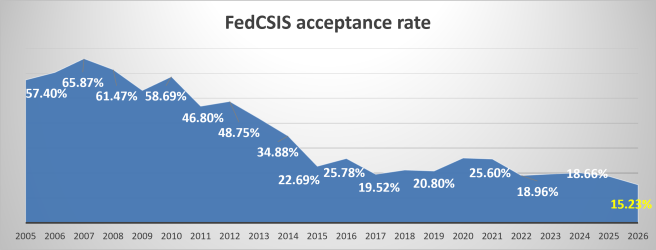
Each contribution, found in this volume, was refereed by at least two referees and the acceptance rate of regular full papers was approximately 15.23\% (32 accepted contributions, out of a total of 210 submissions representing 54 countries and 6 continents). Moreover, 34 contributions have been accepted as regular short papers. This brings the acceptance rate of regular papers (found in this volume) to 31.42% (66 out of 210). Since we live in times when ``data should to be visualized'' to facilitate comprehension, the long-term trend of acceptance of regular full papers is depicted in Figure 1. Note that this year the lowest, thus far, acceptance rate for regular full papers has been recorded.
Committees
Let us now recognize persons who have worked to make FedCSIS 2026 happen, from the scinetific perspective. First, The Senior Program Committee of FedCSIS 2026 consisted of:
- Aiello, Marco, Department of Service Computing, IAAS, University of Stuttgart, Germany
- Alba, Enrique, University of Málaga, Spain
- Arciuch, Artur, Military University of Technology, Poland
- Armando, Alessandro, University of Genova & Fondazione Bruno Kessler, Italy
- Artiemjew, Piotr, University of Warmia and Mazury, Poland
- Atiquzzaman, Mohammed, University of Oklahoma, USA
- Babris, Kristaps, Riga Technical University, Latvia
- Beloff, Natalia, University of Sussex, United Kingdom
- Bethers, Uldis, University of Latvia, Latvia
- Bicevska, Zane, University of Latvia, Latvia
- Blum, Christian, Artificial Intelligence Research Institute (IIIA-CSIC), Spain
- Bosch, Jan, Chalmers University of Technology, Sweden
- Boustras, George, European University, Cyprus
- Brahmi, Zaki, RIADI-Lab, Tunisia
- Bumberger, Jan, Helmholtz Centre for Environmental Research, Germany
- Buyya, Rajkumar, University of Melbourne, Australia
- Bylina, Beata, Maria Curie-Sklodowska University, Poland
- Bylina, Jarosław, Marie Curie-Sklodowska University, Poland
- Cano, Alberto, Virginia Commonwealth University, United States
- Charvat, Karel, Plan4all zs., Czechia
- Chelly Dagdia, Zaineb, University of Lille, France
- Chmielarz, Witold, University of Warsaw, Poland
- Cooper, Anthony-Paul, Durham University, United Kingdom & University of Turku, Finland
- Corizzo, Roberto, American University, USA
- Cornelis, Chris, Ghent University, Belgium
- Coronato, Antonio, ICAR-CNR, Italy
- Cyganek, Bogusław, AGH University of Science and Technology, Poland
- Damaševičius, Robertas, Kaunas University of Technology & Vytautas Magnus University, Lithuania
- Dan, Daniel, Modul University, Austria
- De Muylder, Cristiana, FUMEC University, Brazil
- Debar, Hervé, Télécom SudParis, France
- Dias, Gonçalo, University of Aveiro, Portugal
- Djidjev, Hristo, Los Alamos National Laboratory, USA and Institute of Information and Communication Technologies, Bulgaria
- Dörpinghaus, Jens, Federal Institute for Vocational Education and Training (BIBB), Germany
- Duch, Włodzisław, Nicolaus Copernicus University, Poland
- Dustdar, Schahram, TU Wien and part-time ICREA research professor at UPF, Spain
- Farina, Leandro, Federal University of Rio Grande do Sul, Brazil
- Felkner, Anna, NASK - Research and Academic Computer Network, Poland
- Fidanova, Stefka, Institute of Information and Communication Technologies, Bulgarian Academy of Sciences, Bulgaria
- Fill, Hans-Georg, University of Fribourg, Switzerland
- Franczyk, Bogdan, University of Leipzig, Germany
- Frank, Ulrich, Universität Duisburg-Essen, Germany
- Fred, Ana, Instituto Superior Técnico (IST - Technical University of Lisbon), Portugal
- Furtak, Janusz, Military University of Technology, Poland
- Getir Yaman, Sinem, University of York, United Kingdom
- Guizzardi, Giancarlo, Free University of Bolzano-Bozen, Italy
- Helmrich, Robert, BIBB, Germany
- Herrera, Francisco, University of Granada, Spain
- Hinchey, Mike, Lero - the Irish Software Engineering Research Centre, University of Limerick, Ireland
- Horváth, Zoltán, Eotvos Lorand University, Hungary
- Ioannidis, Sotiris, Technical University of Crete, Greece
- Iwanowski, Marcin, Warsaw University of Technology, Poland
- Janousek, Jan, Czech Technical University Prague, Czechia
- Kacprzyk, Janusz, Systems Research Institute, Polish Academy of Sciences, Poland
- Kadobayashi, Youki, Nara Institute of Science and Technology, Japan
- Kammeyer, Alexander, German Federal Agency for Public Safety Digital Radio, Germany
- Kardas, Geylani, Ege University International Computer Institute, Turkey
- Khemaja, Maha, ISSAT University of Sousse, Tunisia
- King, Irwin, The Chinese University of Hong Kong, Hong Kong
- Kobyliński, Łukasz, Institute of Computer Science, Polish Academy of Sciences, Poland
- Kolukısa Tarhan, Ayça, Hacettepe University, Turkey
- Komorowski, Jan, Uppsala University, Sweden
- Korotov, Sergey, Basque Center for Applied Mathematics, Spain
- Kubis, Marek, Adam Mickiewicz University, Poland
- Kwaśnicka, Halina, Wrocław University of Science and Technology, Poland
- Lacalle Úbeda, Ignacio, Universitat Politècnica de València, Spain
- Leyh, Christian, Technische Hochschule Mittelhessen (THM) - University of Applied Sciences, Germany
- Lirkov, Ivan, Institute of Information and Communication Technologies, Bulgarian Academy of Sciences, Bulgaria
- Luck, Michael, University of Sussex, United Kingdom
- Luković, Ivan, University of Belgrade, Serbia
- Martinelli, Massimo, CNR-ISTI, Italy
- Martínez López, Pablo E., Universidad Nacional de Quilmes, Argentina
- Mernik, Marjan, University of Maribor, Slovenia
- Michalewicz, Zbigniew, University of Adelaide, Australia
- Milašinović, Boris, University of Zagreb, Croatia
- Militzer-Horstmann, Carsta, University Hospital Leipzig, Germany
- Miller, Gloria, maxmetrics, Germany
- Moroni, Davide, ISTI - National Research Council of Italy (CNR), Italy
- Mucherino, Antonio, IRISA, University of Rennes 1, France
- Naeem, Muddasar, University of Naples Parthenope, Italy
- Nakayama, Minoru, Meiji University, Japan
- Naldi, Maurizio, LUMSA University, Italy
- Pałys, Tomasz, Military University of Technology, Poland
- Pedrycz, Witold, University of Alberta, Canada
- Popović, Aleksandar, University of Montenegro, Montenegro
- Prochazka, Ales, University of Chemistry and Technology, Czechia
- Rangel Henriques, Pedro, University of Minho, Portugal
- Raś, Zbigniew, University of North Carolina, United States
- Reinhold, Olaf, University of Cooperative Education Saxony, Germany
- Rishiwal, Vinay, MJP Rohilkhand University, India
- Ristić, Sonja, University of Novi Sad, Serbia
- Rizvi, Syed Tahir Hussain, Wenn AsA, Sandnes, Norway
- Roszczyk, Radosław, Warsaw University of Technology, Poland
- Segal, Michael, Ben-Gurion University of the Negev, Israel
- Skowron, Andrzej, Systems Research Institute Polish Academy of Sciences, Poland
- Slivnik, Boštjan, University of Ljubljana, Slovenia
- Słowiński, Roman, Poznań University of Technology, Poland
- Sołtysik-Piorunkiewicz, Anna, University of Economics in Katowice, Poland
- Spanoudakis, George, City, University of London, United Kingdom
- Speckesser, Stefan, University of Brighton, United Kingdom
- Stanescu, Liana, University of Craiova, Romania
- Stpiczyński, Przemysław, Maria Curie-Sklodowska University, Poland
- Suri, Niranjan, Institute of Human and Machine Cognition, United States
- Śluzek, Andrzej, Warsaw University of Life Sciences, Poland
- Świątkowska, Joanna, ECSO, Belgium
- Taamallah, Aroua, isitcom, Tunisia
- Tiemann, Michael, Federal Institute for Vocational Education and Training (BIBB), Germany
- Tolvanen, Juha-Pekka, MetaCase, Finland
- van der Aalst, Wil, RWTH Aachen University, Germany
- Varanda Pereira, Maria João, Instituto Politécnico de Bragança, Portugal
- Wątróbski, Jarosław, West Pomeranian University of Technology, Poland
- Wróblewska, Anna, Warsaw University of Technology, Poland
- Zadrożny, Sławomir, Systems Research Institute, Polish Academy of Sciences, Poland
- Zaharie, Daniela, West University of Timisoara, Romania
- Zdravevski, Eftim, University Ss.Cyril and Methodius, North Macedonia
- Zheng, Zhigao, Wuhan University, China
- Ziemba, Ewa, University of Economics in Katowice, Poland
- Achour, Sami, University of Sousse, Tunisia
- Almeida Do Carmo, Fernando, State University of Maranhão, Brazil
- Amodio, Pierluigi, Universita' di Bari, Italy
- Anastassi, Zacharias, ASPETE School of Pedagogical and Technological Education, Greece
- Anthopoulos, Leonidas, University of Thessaly, Greece
- Arabas, Piotr, Research and Academic Computer Network, Poland
- Asselborn, Thomas, Universität Hamburg, Germany
- Augusto Pereira de Figueiredo, Felipe, Ghent Univerity, Belgium
- Bacco, Manlio, ISTI-CNR, Italy
- Bachan, Jolanta, Adam Mickiewicz University, Poland
- Bajdor, Paula, Czestochowa University of Technology, Poland
- Banach, Richard, University of Manchester, United Kingdom
- Barsocchi, Paolo, CNR-ISTI, Italy
- Ben Kahla, Mayssa, Issatso, Tunisia
- Ben-Assuli, Ofir, Ono Academic College, Israel
- Bender, Magnus, Aarhus University, Denmark
- Bialas, Andrzej, Research Network Łukasiewicz - Institute of Innovative Technologies EMAG, Poland
- Bjeladinovic, Srdja, University of Belgrade, Serbia
- Bleier, Arnim, GESIS-Leibniz Institute for the Social Sciences, Germany
- Bork, Dominik, TU Wien, Austria
- Braumann, Ulf-Dietrich, Institut für Angewandte Informatik e.V. at the University Leipzig, Germany
- Brdjanin, Drazen, University of Banja Luka, Bosnia and Herzegovina
- Brewster, Christopher, TNO, Netherlands
- Bridova, Ivana, University of Zilina, Slovakia
- Brzoza-Zajęcka, Ada, AGH University of Science and Technology, Poland
- Burczynski, Tadeusz, Polish Academy of Sciences, Poland
- Byrski, Aleksander, AGH University Science and Technology, Poland
- Böhm, Karsten, FH Kufstein Tirol - University of Applies Science, Austria
- Cabri, Giacomo, Università di Modena e Reggio Emilia, Italy
- Calpe Maravilla, Javier, University of Valencia, Spain
- Carbone, Roberto, FBK, Italy
- Carwehl, Marc, Humboldt-Universität zu Berlin, Germany
- Casalino, Gabriella, University of Bari Aldo Moro, Italy
- Chaffe, Pedro, Federal University of Santa Catarina, Brazil
- Cheng, Jiahui, University of Electronic Science and Technology of China, China
- Christozov, Dimitar, American University in Bulgaria, Bulgaria
- Ciucci, Davide, Università di Milano-Bicocca, Italy
- Cutrim Bessa, Ana Carolina, Universidade Estadual do Marnahão, Brazil
- Cybulski, Piotr, Military University of Technology, Poland
- Czachorski, Tadeusz, IITiS Polish Academy of Sciences, Poland
- Czarnacka-Chrobot, Beata, Warsaw School of Economics, Poland
- Czarnul, Pawel, Gdansk University of Technology, Poland
- Dang, Canh Thien, King's College London, United Kingdom
- de Andreis, Federico, Università Giustino Fortunato, Italy
- de Juana-Espinosa, Susana, Universidad de Alicante, Spain
- De Marchi, Stefano, University of Padova, Italy
- Denden, Mouna, Université Polytechnique Hauts-de-France, France
- Derezinska, Anna, Warsaw University of Technology, Poland
- Diez, Luis, Universidad de Cantabria, Spain
- Dimitrieski, Vladimir, Faculty Of Technical Sciences, Serbia
- Dionysiou, Antreas, Frederick University, Cyprus
- Domanska, Joanna, Institute of Theoretical and Applied Informatics, Poland
- Domanski, Adam, Politechnika Slaska, Poland
- Dreżewski, Rafał, AGH University of Krakow, Poland
- Dridi, Ahmed, University of Tunisia, Tunisia
- Dudycz, Helena, Wroclaw University of Economics, Poland
- Duong, Cong Doanh, National Economics University, Viet Nam
- Dutta, Arpita, National University of Singapore, Singapore
- Eisenbardt, Monika, Univeristy of Economics in Katowice, Poland
- Eisenbardt, Tomasz, University of Warsaw, Poland
- Engels, Stefan, Technical University of Munich, Germany
- Esser, Alexander, University of Koblenz / BIBB, Germany
- Evangelidis, Alexandros, University of York, United Kingdom
- Faber, Łukasz, AGH University of Science and Technology, Poland
- Faria, Lincoln, Faculdade de Ciências Médicas da UERJ, Brazil
- Feltus, Christophe, Luxembourg Institute of Science and Technology, Luxembourg
- Fertalj, Krešimir, Faculty of EE and Computing, Croatia
- Fialko, Sergiy, Cracow University of Technology, Poland
- Fourneau, Jean-Michel, DAVID, Universite de Versailles St Quentin, France
- Frommholz, Ingo, Modul University Vienna, Austria
- Fuchs, Carolin, Universitätsklinikum Leipzig, Germany
- Gajinov, Senka, DunavNET do Novi Sad, Serbia
- García-Mireles, Gabriel, Universidad de Sonora, Mexico
- Garitano, Iñaki, Mondragon Unibertsitatea, Spain
- Gepner, Paweł, Warsaw University of Technology, Poland
- Geri, Nitza, The Open University of Israel, Israel
- Getz, Laura, BIBB, Germany
- Gimenez, Pierre-François, Inria, France
- Golak, Slawomir, Silesian University of Technology, Poland
- Gomolińska, Anna, University of Białystok, Poland
- Gong, Xuhui, Jinling Institute of Technology, China
- Grabara, Dariusz, University of Economics in Katowice, Poland
- Grabowski, Mariusz, Cracow University of Economics, Poland
- Gravvanis, George, Democritus University of Thrace, Greece
- Gryncewicz, Wiesława, Uniwersytet Ekonomiczny we Wrocławiu, Poland
- Grzybowska, Katarzyna, Poznan University of Technology, Poland
- Gurgen, Tugba, Hacettepe University, Turkey
- Góźdź, Marek, UMCS, Poland
- Hadj Salem, Khadija, KU Leuven, NUMA, Gent, Belgium
- Halawi, Leila, Embry Riddle Aeronautical Univ, United States
- Hamel, Oussama, University Blida, Algeria
- Hammi, Badis, Telecom-Sud Paris, France
- Hanslo, Ridewaan, University of Cape Town, South Africa
- Hapka, Aneta, Koszalin Univeristy of Technology, Poland
- Heinrich, Ria, Leipzig University, Germany
- Helic, Denis, Technical University of Graz, Austria
- Helsingius, Mika, Finnish Defence Research Agency, Finland
- Henkelmann, Jeanette, Universitätsklinikum Leipzig, Germany
- Henn, Amrei, Uniklinik Leipzig, Germany
- Hernes, Marcin, Wrocław University of Economics and Business, Poland
- Holland-Seydel, Julia, Universitätsklinikum Leipzig, Germany
- Homa, Jarosław, Silesian University of Technology, Poland
- Hopfgartner, Frank, Universität Koblenz, Germany
- Hosobe, Hiroshi, Hosei University, Japan
- Hrach, Christian, Institute for Applied Informatics, Germany
- Hussain, Asad, University of Reading, Italy
- Ignesti, Giacomo, Consiglio Nazionale delle Ricerche (CNR), Italy
- Ilia, Panagiotis, Cyprus University of Technology, Cyprus
- Jacob Junior, Antonio Fernando Lavareda, UEMA, Brazil
- Janicki, Artur, Warsaw University of Technology, Poland
- Janicki, Ryszard, McMaster University, Canada
- Janiszewski, Marek, NASK PIB, Poland
- Jankowski, Jaroslaw, Westpomeranian University of Technology, Poland
- Jarosz, Michał, Wojskowa Akademia Techniczna, Poland
- Jarzebowicz, Aleksander, Gdansk University of Technology, Poland
- Jaskóła, Przemysław, NASK, Poland
- Jassem, Krzysztof, Adam Mickiewicz University, Poland
- Javvad Ur Rehman, Muhammad, Irea-CNR, Italy
- Jelonek, Dorota, Czestochowa University of Technology, Poland
- Johnsen, Frank, Norwegian Defence Research Establishment (FFI), Norway
- Jovancevic, Igor, University of Montenegro, Montenegro
- Jovanovik, Milos, TU Wien, Austria
- Kalibatiene, Diana, VGTU, Lithuania
- Kamola, Mariusz, NASK National Research Institute, Poland
- Kanzari, Dalel, University of Sousse, Tunisia
- Kapczyński, Adrian, Politechnika Śląska, Poland
- Kasprzak, Włodzimierz, Politechnika Warszawska, Poland
- Keir, Paul, University of the West of Scotland, United Kingdom
- Kelner, Jan, Military University of Technology, Poland
- Khalid, Muhammad, Politecnico di Bari, Italy
- Khalid, Umamah Bint, Quaid-I-Azam University, Pakistan
- Khlif, Wiem, FSEGS, Tunisia
- Kilincceker, Onur, University of Antwerp, Belgium
- King, Brannon, United States
- Klarmann, Axel, HTWK Leipzig, University of Applied Sciences, Germany
- Klein, Antonio, Federal University of Santa Catarina, Brazil
- Kobylinski, Andrzej, Warsaw School of Economics, Poland
- Kononova, Anna V., LIACS, Leiden University, Netherlands
- Kordić, Slavica, Faculty of Technical Sciences, Serbia
- Kosmopoulos, Dimitrios, University of Patras, Greece
- Kostadinovska, Katerina, TH Cologne, BIBB, Germany
- Kozak, Jan, University of Economics in Katowice, Poland
- Kozina, Agata, Poland
- Kołodziej, Joanna, NASK Warsaw and Cracow University of Technology, Poland
- Krco, Srdjan, DunavNET, Serbia
- Krdzavac, Nenad, Leibniz Information Centre for Science and Technology (TIB), Germany
- Kucaba-Pietal, Anna, Politechnika Rzeszowska, Poland
- Kucharska, Edyta, AGH University od Science and Technology, Poland
- Kurasova, Olga, Institute of Mathematics and Informatics, Lithuania
- Laborde, Romain, Université de Toulouse, France
- Lasek, Piotr, University of Rzeszów, Poland
- Laskov, Lasko, New Bulgarian University, Bulgaria
- Lechuga, María Pauli
- Lechuga Sancho, Paula, University of Cádiz, Spain
- Leka, Blerta, Agricultural University of Tirana, Albania
- Lerga, Jonatan, University of Rijeka, Croatia
- Lewandowski, Piotr, NASK - Research and Academic Computer Network, Poland
- Li, Shujun, University of Kent, United Kingdom
- Li, Tianrui, Southwest Jiaotong University, China
- Ligęza, Antoni, AGH University of Science and Technology, Poland
- Liu, Bo, Zhengzhou University, China
- Liu, Hao, Shanghai Jiao Tong University, China
- Ljubić, Sandi, University of Rijeka, Croatia
- Lloret, Jaime, Universitat Politècnica de València, Spain
- Loukatos, Dimitrios, Agricultural University of Athens, Greece
- Luque, Gabriel, University of Málaga, Spain
- Luszczek, Piotr, University of Tennessee Knoxville, United States
- Lv, Yuezu, Beijing Institute of Technology, China
- Majdik, Andras L., HUN-REN SZTAKI - Hungarian Research Network, Institute for Computer Science and Control, Hungary
- Mangroliya, Meetkumar Pravinbhai, University of Koblenz, Germany
- Marchiori, Massimo, UNIPD and EISMD, Italy
- Marciniak, Jacek, Adam Mickiewicz University, Poland
- Marciniak, Małgorzata, Institute of Computer Science PAS, Poland
- Marcinkowski, Bartosz, University of Gdansk, Poland
- Markakis, Evangelos, Hellenic Mediterranean University, Greece
- Marques, Ruben, Luxembourg Institute of Science and Technology, Luxembourg
- Martín-Navarro, Alicia, INDESS. University of Cádiz, Spain
- Mascagni, Mario, Brazil
- Matson, Eric, Purdue University, United States
- Mazzara, Manuel, Innopolis University, Russia
- Medeišis, Artūras, Vilnius Gediminas Technical University, Lithuania
- Mele, Valeria, University of Naples Federico II, Italy
- Melzer, Sylvia, University of Hamburg, Germany
- Michalik, Krzysztof, University of Economics in Katowice, Poland
- Micota, Flavia, West University of Timisoara, Romania
- Mikołajewski, Dariusz, Kazimierz Wielki University in Bydgoszcz, Poland
- Mildorf, Tomas, University of West Bohemia, Czechia
- Misra, Nn, Dublin Institute of Technology, Ireland
- Moshkov, Mikhail, KAUST, Saudi Arabia
- Mozgovoy, Maxim, University of Aizu, Japan
- Mullins, Roisin, University of Wales Trinity Saint David, United Kingdom
- Music, Gasper, University of Ljubljana, Slovenia
- Muszyńska, Karolina, University of Szczecin, Poland
- Mykowiecka, Agnieszka, Institute of Computer Science, PAS and Polish-Japanese Academy of Information Technology, Poland
- Myszkowski, Pawel, Wroclaw University of Science and Technology, Poland
- Neubauer, Anja
- Nguyen, Khuong An, Royal Holloway University of London, United Kingdom
- Nicolas, Damien, LIST, Luxembourg
- Niewiadomska-Szynkiewicz, Ewa, Warsaw University of Technology, Poland
- Offerhaus, Judith, Federal Institute for Vocational Education and Training, Germany
- Oppermann, Alexander, Physikalisch-Technische Bundesanstalt, Germany
- Ota, Daniel, Fraunhofer FKIE, Germany
- Paliwoda-Pekosz, Grażyna, Krakow University of Economics, Poland
- Palmigiano, Alessandra, the Vrije Universiteit Amsterdam, Netherlands
- Pankowska, Malgorzata, University of Economics in Katowice, Poland
- Pataricza, András, Budapest University of Technology and Economics, Hungary
- Pellicani, Antonio, Università degli Studi di Bari "Aldo Moro", Italy
- Petcu, Dana, West University of Timisoara, Romania
- Petrović, Veljko, Univerzitet u Novom Sadu, Serbia
- Peukert, Hagen, University of Hamburg, Germany
- Peña, Jose M., Spanish National Research Council (CSIC), Spain
- Piekarz, Monika
- Pires, Ivan Miguel, Universidade de Aveiro, Portugal
- Po, Laura, Universitá di Modena e Reggio Emilia, Italy
- Predoaia, Ionut, University of York, United Kingdom
- Przybyła-Kasperek, Małgorzata, Uniwersytet Śląski w Katowicach, Poland
- Ptaszynski, Michal, Kitami Institute of Technology, Japan
- Quessette, Franck, PRISM -- University of Versailles, France
- Rabbani, Kashif, Digital Catapult, United Kingdom
- Rauch, Jan, Prague University of Economics and Business, Czechia
- Rechavi, Amit, Ruppin Academic Center, Israel
- Reformat, Marek, University of Alberta, Canada
- Reiser, Thomas, University of Koblenz, Germany
- Ribeiro, Pedro, University of York, United Kingdom
- Riediger, Volker, University of Koblenz-Landau, Germany
- Riedinger, Constanze, HTWG Konstanz, Germany
- Ristic, Sonja, University of Novi Sad, Serbia
- Rojek, Krzysztof, Czestochowa University of Technology, Poland
- Rollo, Federica, University of Modena and Reggio Emilia, Italy
- Rossi, Bruno, Masaryk University, Czechia
- Rusho, Yonit, Shenkar, Israel
- Rytel, Marcin, NASK PIB, Poland
- Salvetti, Ovidio, Institute of Information Science and Technologies, CNR, Italy
- Saracino, Andrea, Scuola Superiore Universitaria Sant'Anna di Pisa, Italy
- Saraiva, João, University of Minho, Portugal
- Sawerwain, Marek, University of Zielona Góra, Poland
- Sałabun, Wojciech, West Pomeranian University of Technology, Poland
- Schreiner, Wolfgang, Johannes Kepler University Linz, Austria
- Schulze, Dietmar, Southwestern Baptist Theological Seminary, United States
- Scozzari, Andrea, CNR ISTI, Italy
- Segedinac, Milan, Faculty of Technical Scieneces, Novi Sad, Serbia
- Seif, Lubomir, Prague University of Economics and Business, Czechia
- Shen, Kao-Yi, Chinese Culture University, Taiwan
- Shukla, Aman, New York University, United States
- Sidje, Roger B., University of Alabama, United States
- Siedlecka-Lamch, Olga, Czestochowa University of Technology, Poland
- Sierra, Jose Luis, Universidad Complutense de Madrid, Spain
- Sifaleras, Angelo, University of Macedonia, Greece
- Sikorski, Marcin, Gdansk University of Technology, Poland
- Silva, Gustavo, UEMA, Brazil
- Silvestri, Nicola, Dip. di Scienze Agrarie, Alimentari e Agro-Ambientali, Italy
- Siminski, Krzysztof, Silesian University of Technology, Poland
- Skubalska-Rafajłowicz, Ewa, Wrocław University of Science and Technology, Poland
- Skórzewski, Paweł, Adam Mickiewicz University, Poznań, Poland
- Smywiński-Pohl, Aleksander, AGH University of Science and Technology, Poland
- Sobczak, Andrzej, Warsaw School of Economics, Poland
- Solanki, Vijender Kr., CMR Institute of Technology (Autonomous), India
- Sowański, Marcin, Samsung Research Poland, Poland
- Spangenberg, Norman, Leipzig University, Germany
- Stark, Sandra, Leipzig University, Germany
- Starostka-Patyk, Marta, Warsaw University of Technology, Poland
- Stefanakos, Ioannis, University of York, United Kingdom
- Steiner, Petra, BIBB, Germany
- Storm, Eduard, Institute for Advanced Studies Vienna (IHS), Austria
- Strzelecki, Artur, University of Economics in Katowice, Poland
- Stój, Jacek, Silesian University of Technology, Poland
- Subbotin, Sergey, National University "Zaporizhzhia Polytechnic", Ukraine
- Suraj, Zbigniew, University of Rzeszów, Poland
- Swacha, Jakub, University of Szczecin, Poland
- Syta, Jakub, Akademia Marynarki Wojennej w Gdyni, Poland
- Szabó, Miklós, Eötvös Loránd University , Hungary
- Szczech, Izabela, Poznan University of Technology, Poland
- Szczuka, Marcin, University of Warsaw, Poland
- Szmit, Maciej, University of Lodz, Poland
- Szumski, Oskar, University of Warsaw, Poland
- Szymoniak, Sabina, Czestochowa University of Technology, Poland
- Söylemez, Mehmet, Hacettepe University, Turkey
- Taglino, Francesco, IASI-CNR, Italy
- Telek, Miklos, Budapest University of Technology and Economics, Hungary
- Terra, Marcus, Universidade Estadual de Londrina, Brazil
- Tomczyk, Łukasz, Jagiellonian University, Poland
- Tomovic, Savo, University of Montenegro, Montenegro
- Tortonesi, Mauro, University of Ferrara, Italy
- Udelhofen, Stefan, Federal Institute for Vocational Education and Training, Germany
- Ullah, Zaib, Università Giustino Fortunato – Benevento, Italy
- Valle, Marcos Eduardo, Universidade Estadual de Campinas, Brazil
- Vardanega, Tullio, University of Padua, Italy
- Vasileva, Veronika, University of Koblenz, Germany
- Vasiliadis, Giorgos, Hellenic Mediterranean University and FORTH-ICS, Greece
- Vescoukis, Vassilios, National Technical University of Athens, Greece
- Vogiatzis, Chrysafis, University of Illinois, United States
- Vít, Ondřej, Prague University of Economics and Business, Czechia
- Walters, Kamila, University of Brighton, United Kingdom
- Wang, Tao, Central China Normal University, China
- Wang, Xiaokang
- Waqas, Abdullah, National University of Technology, Pakistan
- Wawer, Aleksander, Institute of Computer Science, Polish Academy of Sciences, Poland
- White, Martin, University of Sussex, United Kingdom
- Wiesmayr, Bianca, Johannes Kepler University Linz, Austria
- Wilcockson, Thomas, Loughborough University, United Kingdom
- Więckowski, Jakub, National Institute of Telecommunications, Poland
- Wojcik, Grzegorz M., Maria Curie-Sklodowska University, Poland
- Wojszczyk, Rafał, Politechnika Koszalińska, Poland
- Wortmann, Andreas, University of Stuttgart, Germany
- Wrona, Konrad, NCIA, Poland
- Wróblewska, Alina, Polish Academy of Sciences, Poland
- Wyrzykowski, Roman, Czestochowa University of Technology, Poland
- Węcel, Krzysztof, Poznan University of Economics and Business, Poland
- Xenakis, Christos, University of Piraeus, Greece
- Zacepins, Aleksejs, Latvia University of Life Sciences and Technologies, Latvia
- Zargayouna, Mahdi, Université Gustave Eiffel, France
- Zaza, Gianluca, Italy
- Zborowski, Marek, University of Warsaw, Poland
- Zhao, Dan, Southeast University, China
- Zhivkov, Petar, Bulgarian Academy of Sciences, Bulgaria
- Zieliński, Zbigniew, Military University of Technology, Poland
- Zielosko, Beata, University of Silesia in Katowice, Poland
- Ziemba, Paweł, University of Szczecin, Poland
- Ziętkiewicz, Tomasz, Samsung R&D Institute Poland, Poland
- Zotos, Leonidas, University of Groningen, Netherlands
- Zurutuza, Urko, Mondragon Unibertsitatea, Spain
- Štěpánek, Lubomír, Charles University; University of Economics, Czechia
- Cetnarowicz-Jutkiewicz, Anna, Polskie Towarzystwo Informatyczne, Poland
- Denisiuk, Aleksander, University of Warmia and Mazury in Olsztyn, Poland
- Maciaszek, Leszek, Macquarie University, Australia
- Nikiforova, Oksana, Riga Technical University, Lithuania
Acknowledgments
In conclusion, let us emphasize that the delivery of FedCSIS 2026 required a dedicated effort of many people. We would like to express our warmest gratitude to all Topical Area Curators, Thematic Session organizers, members of the FedCSIS 2026 Senior Program Committee, and members of the FedCSIS 2026 Program Committee (a total of more than 300 individuals), for their hard work in attracting and reviewing all submissions. We thank the authors of papers for their great contribution to the theory and practice of Computer Science and Intelligence Systems. We are grateful to Keynote and Invited Speakers for sharing their knowledge and experiences with the participants. Last, but not least, we acknowledge, one more time, Andrejs Romānovs, Megija Krista Miļūne, Rihards Bobkovs, Uldis Karlovs-Karlovskis, Kristaps Babris, Veronika Tatjana Vucāne, Zane Bičevska Anastasiya Danilenka and Paweł Szmeja, as well as a fantastic group of student helpers. We are very grateful for your efforts!
We also hope to meet you again for the 22nd Conference on Computer Science and Intelligence Systems (FedCSIS 2027), which will take place in Gdynia, Poland, on September 12-15, 2027.
Co-Chairs of the FedCSIS Conference Series
Marek Bolanowski, Rzeszow University of Technology, Poland.
Maria Ganzha, Warsaw University of Technology, Poland and Systems Research Institute Polish Academy of Sciences, Warsaw, Poland.
Marek Grzegorowski, Samsung Research, Warsaw, Poland.
Leszek Maciaszek, Wrocław University of Economics and Business, Wrocław, Poland and Macquarie University, Sydney, Australia.
Marcin Paprzycki, Systems Research Institute Polish Academy of Sciences, Warsaw Poland and Management Academy, Warsaw, Poland.
Andrzej Paszkiewicz, Rzeszów University of Technology, Poland.
Dominik Ślęzak, Institute of Informatics, University of Warsaw, Poland and QED Software, Poland and DeepSeas, USA.
Main Track Invited Contributions
-
Mining Bureaucracy Debt: Process Intelligence for Evidence-Based Deregulation
8734 administrative process intelligence, digitization, deregulation Wil M.P. van der Aalst, pages 1–11. Invited -
EnsembleClassifier: Using Machine Learning to Select Exact Packet Classification Structures for Partitioned Rule Subsets
4917 Machine Learning, Networking, Packet classification Ashesh Gaur, Sridhar Radhakrishnan, Mohammed Atiquzzaman, pages 13–19. Invited -
The Algorithmic Challenges and Opportunities in Tracing Meaning at Scale in Large Historical Document Collections
8031 Natural Language Processing, Artificial Intelligence, Semantics Filip Ginter, Mikko Tolonen, Anna Plassart, Jenna Kanerva, Kira Hinderks, Yu Wu, pages 21–24. Invited -
Enabling Agentic AI across the Cloud-Edge Computing Continuum: A Research Roadmap
0210 Artificial Intelligence, Agentic AI, Cloud-Edge Continuum Radu Prodan, Hui Song, Arda Goknil, Dumitru Roman, Maria Fazio, Massimo Villari, Massimo Mecella, Maryam Doborjeh, Nikola K. Kasabov, JeongGil Ko, Hyunwhan Joe, Hong-Gee Kim, Thomas Fahringer, Zahra Najafabadi pages 25–32. Invited -
Preserving Optimization Algorithm Expertise by means of Executable Algorithm Knowledge Graphs: A Worked Example on the TSP
2986 executable knowledge graphs, procedural knowledge, ant colony optimization, automatic algorithm design, traveling salesman problem Camilo Chacón Sartori, José H. García, Andrei V. Tomut, Christian Blum, pages 33–40. Invited -
Evolution of Approximation Spaces in Rough Sets: From Relational Systems to Complex Adaptive Systems
7351 (interactive) granular computing (IGrC), complex granule (c-granule), control of c-granule, rough sets in IGrC, dynamic approximation space in IGrC, approximation of c-granule, complex adaptive system (CAS) Andrzej Skowron, Dominik Ślęzak, pages 41–54. Invited
Main Track Regular Papers
-
A Real-World Dataset of LLM Jailbreak Prompts from a Capture-the-Flag Challenge
5600 LLMs, prompt injection, adversarial attacks, jailbreak, CTF, offensive/defensive prompts, dataset Jan Czajkowski, Filip Graliński, pages 55–64. SAIS -
Human–AI Collaboration in Maturity Model Development: Evidence from Big Data Analytics Assessment Criteria
5552 big data, GenAI, Maturity Marija Ðukić, Jozo Dujmović, Ivan Luković, pages 65–82. AAIA -
Towards LLM-Based Context Engineering for Model-Driven Vibe-DevOps-Engineering of Cross-Platform CI/CD Pipeline Support
5402 model-driven engineering, CI/CD, LLM, context engineering, ATL, Acceleo, RAG, multi-agent systems, vibe DevOps engineering, vibe, DevOps Uldis Karlovs-Karlovskis, pages 83–93. IS3E -
Outbound Traffic Control in Call/Contact Center Systems Using the TD3 Algorithm
4509 reinforcement learning, call/contact center systems, outbound traffic control, TD3 model Marcin Kozłowski, Mirosław Płaza, Małgorzata Lucińska, Marcin Kowalczyk, pages 95–104. IS3E -
Regression Exception Rules
8053 Exception rules, Knowledge discovery, Rule-based learning, Regression Dawid Macha, Łukasz Wróbel, Marek Sikora, pages 105–113. AAIA -
Accountability Mechanisms in AI Projects: An Empirical Analysis of Governance, Performance Control, Delivery, and Misconduct Management
9366 Artificial Intelligence, AI Projects, Accountability Mechanisms, AI Governance, Project Governance, Reviewability, Transparency, Explainability, Risk Management, Stakeholder Engagement Gloria Miller, pages 115–127. ITBS -
Regulatory Analysis of Machine Learning in Smart Meter Gateway: Legal Metrology Perspective
4395 smart meter gateway, legal metrology, machine learning, regulatory analysis Mahbuba Moni, Daniel Peters, Florian Thiel, Axel Sikora, pages 129–140. AAIA -
Critical Success Factors for Low-Code / No-Code Adoption in Organizations: Insights from the Literature
3165 Low-Code, No-Code, Critical Success Factors, CSF, Literature Review Paul Rozbitski, Moritz Fabius Zeitfuchs, Christian Leyh, pages 141–154. ITBS -
Real-time Verification of Container Seal Integrity using Deep Learning
0497 computer vision, deep learning, container seal detection, container door detection, maritime container terminal Sotiris Vasileiadis, Sijun Yu, Kyriacos Orphanides, Alessandro Cassera, Michalis Michaelides, Herodotos Herodotou, pages 155–164. AAIA -
Voicemail Detection in Telephone Recordings for Call/Contact Center Systems Using Hierarchical Spectral Windowing
7609 voicemail detection, call/contact center, Discrete Fourier Transform, pectral feature extraction, hierarchical windowing, multilayer perceptron Michał Zawadzki, Mirosław Płaza, Marcin Kowalczyk, pages 165–172. IS3E -
SARIMAX as a Reference Model for Emission Intensity Forecasting for HPC Systems
4766 Time Series Forecast, Reasonable Reference Model, SARIMAX, HPC, Emission Intensity Forecast, Machine Learning Michael Zent, Daniel Lübbert, Florian Burger, Alexander Kammeyer, pages 173–184. IDPI
Main Track Short Papers
-
Enhancing Automated Valuation Models with LLM-based Feature Engineering and Spatial Indices and a RAG-Integrated Web Application for Trójmiasto Residential Market
2863 Automated Valuation Module, Retrieval Augmented Generation, Large Language Models, Machine Learning, Real Estate Piotr Kłopotowski, Olgun Aydin, pages 185–190. ITBS -
Multi-Task U-Net Architecture for Tumor Segmentation and Recognition based on Fractal Analysis and Nonlinear Reaction-Diffusion
4871 Brain tumor segmentation and classification, Magnetic Resonance Imaging, multi-task U-Net, fractal layers, nonlinear reaction-diffusion, fractal expansion, attention module Tudor Barbu, Lucian Murgu, pages 191–196. AAIA -
Container-based Machine Learning-Driven Routing Framework for Adaptive Traffic Management in Real-World SDN Environments
6690 Machine Learning, SDN, Docker-containers, FRRouting, REST-API, OSPF Mariem Bouguerra, Khalfallah Sofiane, Ltifi Hela, pages 197–202. IDPI -
Emulating a Continuous Deployment Environment Using Locally Run GitHub Actions and a Containerized Deployment Server
3957 continuous deployment, GitHub Actions, nektos/act, Docker, CI/CD pipelines, DevOps, education Boris Milašinović, Juraj Dončević, Krešimir Fertalj, pages 203–208. IS3E -
Searching for Accuracy vs. Efficiency Trade-off Solution in Deep Differentiable Logic Gate Networks
6629 Differentiable Logic Gate Networks, Continuous Fuzzy Logic Gate Networks, Binary Logic Gate Networks, Continuous Relaxation, Discretization and Binarization, Interpretable AI Chan Duong Nguy, Piotr Wasilewski, pages 209–214. AAIA -
Server-Side Machine Learning for Cheat Detection in Massively Multiplayer Online Role-Playing Games
1905 cheat detection, MMORPG, one-class SVM, Affinity Propagation, anomaly detection, game security, server-side anti-cheat, machine learning Konrad Operacz, Hubert Zembrowski, Robert Kłopotek, pages 215–220. SAIS
Thematic Sessions
Preface to Thematic Sessions
Parts 4 and 5 of FedCSIS 2026 Proceedings contain contributions originating from the Thematic Sections. Let us briefly introduce each one of them (in alphabetical order).
AI in Agriculture
Artificial Intelligence (AI) is increasingly used in agriculture for a variety of uses, from plant disease detection to weeding automation, soil status monitoring, crop prediction, irrigation management, and decreased use of resources for improving quality and productivity. This Thematic Session welcomes contributions related to a wide variety of interdisciplinary research and applications related to the application of intelligence systems in agriculture. AI can, in fact, provide highly positive effects on precision agriculture by optimizing, automating, and forecasting several aspects of farming and revolutionizing the sector, providing helpful information and driving decisions using multiple sources of data and different sensors.
Moreover, in the climate change era, AI can improve sustainability by optimizing resources such as water and soil management as well as fostering novel methods and approaches. We welcome innovative contributions, early results, and position papers addressing one or more of the topics listed below. We intend to foster informal discussions and bring together researchers, practitioners, and industry experts to explore the challenges and opportunities of intelligence systems and agriculture.
This Thematic Session was organized by:
- Martinelli, Massimo, Institute of Information Science and Technologies, National Research Council of Italy, Italy
- Moroni, Davide, Institute of Information Science and Technologies, National Research Council of Italy, Italy
- Procházka, Ales, University of Chemistry and Technology and Czech Technical University CIIRC, Czech Republic
- Charvat, Karel, Czech Center for Science and Society, Czech Republic
AI in Digital Humanities, Computational Social Sciences and Economics Research (AI-HuSo)
This thematic session is dedicated to the computational study of Social Sciences, Economics and Humanities, including all subjects like, for example, education, labour market, history, religious studies, theology, cultural heritage, and informative predictions for decision-making and behavioural-science perspectives. While digital methods, intelligence systems, and AI have been emerging topics in these fields for several decades, this thematic session is not only limited to discoveries in these domains, but also dedicated to the reflections of these methods and results within the field of computer science. Thus, we are in particular interested in interdisciplinary exchange and dissemination with a clear focus on computational and AI methods for intelligence systems. Since there is a clear methodological overlap between these three domains and often similar algorithms and AI approaches are considered, we see this thematic session as place for interdisciplinary learning, discussing a joint toolbox as a support for scholars from these field with human and context-aware agents. The aim of this thematic session is thus to bridge the gap between scientific domains, foster interdisciplinary exchange and discuss how research questions from other domains challenge current computer science. In particular, we are interested in communications between researchers from different fields of computer science, social sciences, economics, humanities, and practitioners from different fields.
This Thematic Session was organized by:
- Dörpinghaus, Jens, BIBB and University of Koblenz, Germany
- Helmrich, Robert, BIBB and University of Bonn, Germany
- Tiemann, Michael, BIBB and University of Koblenz, Germany
- Speckesser, Stefan, Brighton University, United Kingdom
- Cooper, Anthony-Paul, Durham University, United Kingdom and University of Turku, Finland
AI for Inland Water, Atmospheric Environments, and Ocean Modelling (AIWAVOM)
AI for Inland Water, Atmospheric Environments, and Ocean Modelling (AIWAVOM) brings together researchers applying intelligent systems to understand and predict the full water--atmosphere continuum. The session spans rivers, lakes, wetlands, the atmosphere, coastal zones, and the open ocean, recognizing that extreme events often emerge from interactions across these domains.
We welcome contributions that turn data (in situ observations, remote sensing, reanalyses, and high-resolution simulations) into insight for weather prediction, climate assessment, and environmental forecasting: from extreme waves, storm tides, and compound flooding to atmospheric rivers, hydro-climatic extremes, and air--sea exchange processes.
We are particularly interested in hybrid and knowledge-guided approaches: physics-aware learning, neural operators for geophysical fields, AI-based downscaling, probabilistic and uncertainty-aware forecasts, and symbolic or neural-symbolic methods for process discovery. Case studies linking inland hydrology, meteorology, and oceanography, as well as applications relevant to ports, renewable energy, civil protection, and water-resource management, are especially encouraged.
The goal is to foster a practical, cross-disciplinary conversation about what AI can contribute to environmental prediction today, and where it can take us next.
This Thematic Session was organized by:
- Farina, Leandro, Federal University of Rio Grande do Sul, Brazil
- Korotov, Sergey, Mälardalen University, Sweden
- Bethers, Uldis, University of Latvia, Latvia
Advances in Programming Languages (APL)
Programming languages are the most fundamental tools for programmers. With the right programming languages, one can significantly reduce the cost of building new applications and maintaining existing ones. Over the last few decades, there have been substantial advances in programming language technology within traditional paradigms such as functional, logic, object-oriented, and aspect-oriented programming.
Today the growing influence of artificial intelligence on programming paradigms and the development of software systems is rapidly reshaping the field. Above all, programming tools based on generative artificial intelligence have become a standard, transforming programming practices in both academia and industry. The methods and approaches for selecting, adapting, and evaluating AI techniques for programming language design and implementation have become a critical area of research.
Within this context, new advances in programming language research are also contributing to the design and implementation of autonomous and intelligent systems, such as those developed under the umbrella of agent-oriented programming. The primary motivation has always been, and will continue to be, to enable a more effective formulation of programmers' ideas. As a result, research in programming languages remains a perpetual activity and lies at the core of computer science.
Hence, new language features and programming paradigms---particularly those enhanced by AI techniques---as well as improved compile-time and run-time mechanisms, can be anticipated in the near future.
The aims of this Thematic Session are to provide a forum for the exchange of ideas and experiences in topics related to programming languages and systems. Original papers and implementation reports are invited in all areas of programming languages.
This Thematic Session was organized by:
- Rangel Henriques, Pedro, Universidade do Minho, Portugal
- Slivnik, Boštjan, University of Ljubljana, Slovenia
- Janousek, Jan, Czech Technical University, Czech Republic
- Varanda Pereira, Maria Joao, Instituto Politecnico de Braganca, Portugal
Computer Aspects of Numerical Algorithms (CANA)
Numerical algorithms are widely used by scientists engaged in various areas. There is a special need of highly efficient and easy-to-use scalable tools for solving large scale problems. This Thematic Session is devoted to numerical algorithms with the particular attention to the latest scientific trends in this area and to problems related to implementation and utilization of libraries of efficient numerical algorithms.
The goal is the meeting of researchers from various institutes and exchanging of their experience, and integrations of scientific centers.
This Thematic Session was organized by:
- Bylina, Beata, Maria Curie-Sklodowska University, Poland
- Bylina, Jarosław, Maria Curie-Sklodowska University, Poland
- Cyganek, Bogusław, AGH University of Krakow, Poland
- Lirkov, Ivan, Institute of Information and Communication Technologies, Bulgarian Academy of Sciences, Bulgaria
- Stpiczyński, Przemysław, Maria Curie-Sklodowska University, Poland
Challenges for Natural Language Processing (CNLPS)
Natural Language Processing technologies enable Intelligence Systems to analyze, interpret, and generate human language, enhancing their capabilities to communicate and make informed decisions. This Thematic Session is dedicated to natural language processing methods that address challenging, non-obvious problems with the goal of advancing human language technologies.
Special attention is given to tools that approach multilingual tasks, utilize cross-lingual learning and process natural languages that are not widely represented in other events.
This Thematic Session was organized by:
- Kobyliński, Łukasz, Institute of Computer Science, Polish Academy of Sciences, Poland
- Kubis, Marek, Adam Mickiewicz University, Poland
Computational Optimization (CO)
In the real world, Intelligence Systems address numerous problems in the fields of engineering, economics, medicine, and other domains. Many of these problems can be formulated as optimization tasks, in particular, we may consider challenges that are frequently characterized by non-convex, non-differentiable, discontinuous, noisy, or dynamic objective functions and constraints that ask for adequate computational methods.
The aim of this Thematic Session is to stimulate communication between researchers working on different fields of optimization and practitioners who need reliable and efficient computational optimization methods.
We invite original contributions related to both theoretical and practical aspects of optimization methods.
This Thematic Session was organized by:
- Fidanova, Stefka, Institute of Information and Communication Technologies at Bulgarian Academy of Sciences, Bulgaria
- Mucherino, Antonio, IRISA, University of Rennes, France
- Zaharie, Daniela, West University of Timisoara, Romania
Data Science in Health, Ecology and Commerce (DSH)
Data Science in Health, Ecology and Commerce is a thematic session that focuses on the intersections of data analysis, data economics, information systems, and data-based research. The workshop explicitly highlights the interaction among these four fields and encourages interdisciplinary research.
It aims to foster data-driven solutions by deepening our understanding of complex, real-world challenges---such as smart health services, the influence of ecological factors on well-being, or the economic effects of sustainable infrastructures---and by applying critical thinking and analytical methods to derive knowledge from (big) data.
In recent years, interest in innovative data technologies and analytics has grown substantially. Emerging solutions now link and utilize large amounts of data across diverse digital ecosystems. These developments support new application scenarios that integrate data from IoT devices, social media, and various information systems, demonstrating the significant potential of data science for generating insights, supporting decisions, and enabling smarter services in health, ecology, and commerce.
However, we are still at the beginning of this journey. Further exploration is needed regarding the methods and technologies required, the potential application fields, and the broader societal and economic impacts. This requires expertise from researchers across disciplines, bringing diverse perspectives and methodological approaches to better understand the opportunities and transformative power of data science.
We warmly invite submission of papers approaching these topics from medical, technological, economic, ecological, political, or societal perspectives.
This Thematic Session was organized by:
- Militzer-Horstmann, Carsta, University of Leipzig Medical Center and Information Systems Institute, Germany
- Reinhold, Olaf, Cooperative State University Saxony, Germany
- Bumberger, Jan, Helmholtz Centre for Environmental Research, Germany
- Franczyk, Bogdan, Wroclaw University of Economics, Poland and Leipzig University, Germany
- Fernandes De Muylder, Cristiana, Universidade FUMEC, Brazil
Education & AI systems (EDUC-AI-TION)
Etymologically, the word ``school'' originally meant ``leisure,'' or from the ancient Greek $\sigma\kappa{o}\lambda\eta$ (scholē). Today, this foundational sense of leisure has often been lost as modern education focuses heavily on efficiency and structure. However, recent advances in AI technology, particularly generative AI (GenAI), have opened doors to newly creative ways of transmitting and sharing knowledge.
This Thematic Session seeks to explore the transformative potential of AI-driven tools, especially chatbots and conversational agents, in education.
We invite researchers and educators to share insights and innovative solutions that can shape the future of learning. This session welcomes perspectives ranging from critical assessments to enthusiastic endorsements of AI's role in education. Particular attention is given to the possibilities offered by new AI technologies, transformation of educational approaches, standards and best practices, as well as the positive aspects, threats, and challenges associated with AI implementation.
The session also explores how AI tools can make education more creative, high-quality, and accessible, especially for underprivileged groups, and how GenAI can enhance informed decision-making while addressing potential threats and security issues.
This Thematic Session was organized by:
- Dan, Daniel, MODUL University, Austria
- Nakayama, Minoru, Meiji University, Japan
- Wróblewska, Anna, Warsaw University of Technology, Poland
Internet of Things -- Enablers, Challenges and Applications (IoT-ECAW)
The Internet of Things (IoT) is a rapidly evolving paradigm in which physical objects equipped with sensing, actuation, communication, and computing capabilities are interconnected to enable intelligent services and data-driven decision-making. Advances in networking technologies, embedded and cyber-physical systems, edge and cloud computing, and artificial intelligence have significantly expanded the scale, functionality, and impact of IoT deployments across a wide range of application domains.
In particular, the integration of AI---often deployed at the network edge---enables real-time decision-making, intelligent automation, predictive analytics, and anomaly detection, further accelerating the adoption of IoT in industry and society.
This thematic session provides an interdisciplinary forum for researchers, academics, and practitioners to present and discuss recent theoretical advances, technological innovations, and practical experiences related to IoT systems. The scope encompasses enabling technologies and architectures, key technical and societal challenges, and real-world applications of IoT, with particular attention to the role of artificial intelligence in enhancing automation, security, reliability, and operational efficiency.
This thematic session invites original, high-quality research papers, surveys, experimental studies, implementation reports, and position papers from academia and industry. Contributions that explore the synergy between IoT and artificial intelligence, address open challenges in networking, security, reliability, and data management, or demonstrate innovative and impactful IoT applications are particularly encouraged.
This Thematic Session was organized by:
- Arciuch, Artur, Military University of Technology, Poland
- Fornés Leal, Alejandro, Universitat Politècnica de València, Spain
- Lacalle Úbeda, Ignacio, Universitat Politècnica de València, Spain
- Pałys, Tomasz, Military University of Technology, Poland
- Rishiwal, Vinay, MJP Rohilkhand University, India
Information Systems Management (ISM)
This thematic session has long served as a forum for the exchange of ideas for practitioners and theoreticians dealing with the broad issues of information systems management in organizations and society.
We invite papers in four complementary areas: the use of AI and RPA to support management in companies and society, information systems management in organizations, the place and role of IT in empowering managers within organizations, and aspects of sustainable development in management information systems.
We are particularly interested in the adaptation of modern technologies in management information systems, i.e., the potential use of artificial intelligence, robotics, process automation, and business intelligence to support the work of IT specialists and managers, decision-making, and guiding the strategic development of organizations.
We also welcome papers on the impact of information systems on sustainable development and the development of methods for assessing this process, moving towards multi-criteria methods.
This Thematic Session was organized by:
- Chmielarz, Witold, University of Warsaw, Poland
- Leyh, Christian, Technische Hochschule Mittelhessen (THM) -- University of Applied Sciences, Germany
- Sołtysik-Piorunkiewicz, Anna, University of Economics in Katowice, Poland
- Bicevska, Zane, University of Latvia, Latvia
Model Driven Approaches in System Development (MDASD)
Model-Driven (MD) approaches have long enabled developers to specify systems at appropriate abstraction levels, separating design intent from platform-specific implementation details. By elevating models from documentation to primary development artifacts, MD approaches shift focus from low-level programming to higher-level modeling activities where software code, tests, configurations and other artefacts can be systematically generated from well-defined specifications.
By providing shared, abstract, and semantically rich representations of systems, MD approaches also facilitate effective collaboration and communication among diverse stakeholders, including domain experts, developers, system engineers, and end users, thereby enabling their early and continuous participation throughout the development lifecycle.
In the AI era, MD approaches provide a structured framework for the design, development and optimization of complex systems by creating models that represent different system components, learning algorithms, neural networks and/or other components of a system. At the same time, adaptability is increased as the entire system can be updated quickly without having to rewrite large parts of the code, making it easier to integrate new functions or intelligent components.
This MD theme brings together researchers and practitioners working on model-driven approaches, techniques, and tools with applications across intelligent and information systems. Our goal is to foster experience sharing, spark new ideas, and advance the evaluation and dissemination of MD methodologies.
We embrace the interdisciplinary nature of model-driven software development, welcoming contributions spanning Model Driven Software Engineering (MDSE), Model Driven Development (MDD), Domain Specific Modeling (DSM), and OMG's Model Driven Architecture (MDA).
Beyond exploring MD applications in intelligent systems, we particularly encourage work addressing a critical contemporary challenge: how to effectively deploy modern AI and ML techniques within software development processes using the full spectrum of MD approaches.
This Thematic Session was organized by:
- Milašinović, Boris, University of Zagreb, Croatia
- Ristić, Sonja, University of Novi Sad, Serbia
- Tolvanen, Juha-Pekka, MetaCase, Finland
Multimedia Applications and Processing (MMAP)
Multimedia data have become a fundamental component of modern information systems, encompassing visual, auditory, textual, and sensory modalities. The rapid growth of multimedia content has created new challenges in representation, understanding, indexing, retrieval, interaction, and generation of complex data streams. Addressing these challenges requires advanced methods that combine signal and image processing, computer vision, machine learning, and artificial intelligence.
Recent advances in large-scale pre-trained and foundation models, multimodal learning, and generative AI have profoundly transformed multimedia processing and analysis. Vision--language--audio models, diffusion-based generative techniques, and transformer architectures now enable unified understanding and synthesis of multimedia content, opening new opportunities for intelligent, interactive, and human-centered systems.
These developments impact a wide range of domains, including healthcare, industry, education, creative media, autonomous systems, and public services.
At the same time, new research challenges have emerged, such as efficient and sustainable model design, learning with limited or noisy data, robustness and trustworthiness of AI systems, explainability, and deployment on edge and embedded platforms.
The MMAP Thematic Session provides a forum for researchers and practitioners to discuss recent advances, emerging trends, and future challenges in multimedia, vision, graphics, and multimodal AI. The session aims to foster interdisciplinary exchange and collaboration between communities working on theoretical foundations, algorithmic developments, system design, and real-world applications.
We invite original, previously unpublished contributions that are not under consideration elsewhere. Submissions may address conceptual, methodological, or application-oriented aspects of multimedia and multimodal intelligent systems, with particular emphasis on innovative, scalable, and impactful solutions.
Paper acceptance and publication will be based on relevance to the session theme, originality, technical quality, clarity of presentation, and significance of results.
This Thematic Session was organized by:
- Kwaśnicka, Halina, Wrocław University of Science and Technology, Poland
- Stanescu, Liana, University of Craiova, Romania
- Iwanowski, Marcin, Warsaw University of Technology, Poland
- Śluzek, Andrzej, Warsaw University of Life Sciences, Poland
International Forum on Cyber Security, Privacy, and Trust (NEMESIS)
In today's digital and AI-driven age, information security forms a critical foundation for protecting user data, electronic transactions, and increasingly intelligent systems. Safeguarding communications, data infrastructures, and AI models in a constantly evolving, interconnected world is crucial. Security as a scientific discipline now includes complex challenges that require collaboration among computer science, engineering, information systems, intelligence systems, and AI communities.
The International Forum on Cyber Security, Privacy, and Trust (NEMESIS'26) highlights diverse developments and deployments in cyber information security and artificial intelligence security. It aims to address current challenges and present the latest research contributions at the intersection of cybersecurity and AI. The forum serves as a platform to explore technical security aspects, innovative privacy-preserving techniques empowered by AI, and trust frameworks in emerging intelligent systems.
Additionally, it broadens its scope to cover newly prominent topics such as AI security, adversarial learning, social, organizational, and intelligence system-driven security research directions. NEMESIS'26 provides an inclusive forum for presenting theoretical and applied research papers, case studies, implementation experiences, and work-in-progress results in cybersecurity.
NEMESIS'26 is designed to attract researchers and practitioners from academia and industry, creating an international platform to exchange ideas and experiences in the evolving dimensions of information security and AI applications across various application domains. This initiative fosters identification of new research directions and the tackling of modern research challenges, focusing on both securing AI and leveraging AI for enhanced security.
This Thematic Session was organized by:
- Felkner, Anna, Naukowa i Akademicka Sieć Komputerowa, Poland
- Kadobayashi, Youki, Nara Institute of Science and Technology, Japan
- Ioannidis, Sotirios, Technical University of Crete, Greece
- Świątkowska, Joanna, European Cyber Security Organisation, Belgium
- Debar, Hervé, Télécom SudParis, Institut Mines-Télécom, France
Agentic AI in Smart Cities (SCA)
Smart cities strategy design is a relatively new research field that appeared with the concept of smart city. It consists on the development of innovative solutions to increase the quality of life of a given city and ensure its sustainability. The design of smart cities strategies is a laborious and hard task. It requires a lot of efforts from stakeholders to identify the city problems and develop strategies that solve those problems.
Technologies like Internet of Things, Artificial Intelligence (AI) are employed to build city infrastructure and citizen-oriented services. Agentic AI is a new but promising concept that could involve Internet of Things (Internet of Agents), AI techniques like Reinforcement Learning.
Agentic AI systems in Smart City involves agents, humans and external tools that work together to take decisions and extract data at real time. Such type of systems could reshape the vision of the smart city in different contexts such as data retrieval, decision-making and city governance.
The researchers are invited to propose methodologies, systems, infrastructures and services that emphasize human-agent interactions in such systems, infrastructures and citizen-oriented environments.
This Thematic Session was organized by:
- Taamallah, Aroua, University of Sousse, Tunisia
- Khemaja, Maha, University of Sousse, Tunisia
- Brahmi, Zaki, ETS, Canada
Self Learning and Self Adaptive Systems (SLSAS)
The proposed thematic session is focused on advanced Artificial Intelligence (AI) techniques and their applications in various fields. One of the advanced forms of AI methods is the Reinforcement Learning (RL) algorithms. RL or Self-learning systems are AI agents able to acquire and renew knowledge over time without hard coding. These are adaptive systems whose functions improve by a learning process based -- typically -- on the method of trial and error.
A self-learning system initially interacts with its users or surrounding environment by attempting and observing the changes produced by its actions. This session will focus on the design, implementation, and exploitation of self-learning features within an Intelligent Environment or some of its components. The thematic session will represent an opportunity for academia and industry to debate the state-of-the-art challenges and open issues.
This Thematic Session was organized by:
- Naeem, Muddasar, Università Giustino Fortunato, Italy
- Coronato, Antonio, Università Giustino Fortunato, Italy
- Rizvi, Syed Tahir Hussain, Wenn AsA, Norway
Industrial Track -- Practical Insights into Intelligent Systems (INDT)
The Industrial Track offers companies and professionals the opportunity to share real-world experiences, case studies, and practical applications of intelligent systems and AI-based solutions. We welcome presentations (or posters) that showcase successful implementations, challenges faced in industry, or open problems where academic collaboration could be valuable.
Industry representatives are invited to participate by submitting a short informal proposal describing the planned talk or presentation. A brief summary (a few paragraphs) outlining the topic, practical context, and key takeaways is sufficient.
Scientific paper submission is not required for participation in the Industrial Track. However, inclusion of a contribution in the post-conference materials (Position or Communication Papers) is possible and encouraged.
The format of the contribution is flexible and can be agreed individually (oral presentation, poster, or a combination of both).
The Industrial Track is practice-oriented and intended to facilitate knowledge exchange between industry and academia. Contributions are evaluated based on relevance and practical value rather than scientific novelty.
This Industrial Track was organized by:
- Babris, Kristaps, Riga Technical University, Latvia
Co-Chairs of the FedCSIS Conference Series
Marek Bolanowski, Rzeszow University of Technology, Poland.
Maria Ganzha, Warsaw University of Technology, Poland and Systems Research Institute Polish Academy of Sciences, Warsaw, Poland.
Marek Grzegorowski, Institute of Informatics, University of Warsaw, Poland and QED Software, Poland and DeepSeas, USA.
Leszek Maciaszek, Wrocław University of Economics and Business, Wrocław, Poland and Macquarie University, Sydney, Australia.
Marcin Paprzycki, Systems Research Institute Polish Academy of Sciences, Warsaw Poland and Management Academy, Warsaw, Poland.
Andrzej Paszkiewicz, Rzeszów University of Technology, Poland.
Dominik Ślęzak, Institute of Informatics, University of Warsaw, Poland and QED Software, Poland and DeepSeas, USA.
Thematic Sessions Regular Papers
-
Deterministic Measurement-Conditioned 3D Body Reconstruction for Precision Digital Fitting
2980 anthropometric measurements, 3D body generation, deterministic regression, measurement-conditioned mesh generation, digital fitting Olga Barbina, Zane Bicevska, pages 227–237. MMAP -
A Model-Based Testing Framework For Distributed Simulations
2984 MBT, HLA, ComMA Tom van den Berg, Mathijs Schuts, Jeroen Voogd, pages 239–249. MDASD -
Embedding-Level Pretraining for Assembly-Level Vulnerability Detection Using Transformer Models
7378 Vulnerability detection, Embedded systems, Deep learning, Representation learning, Assembly code analysis Dominik Ciesiołkiewicz, Mirosław Łazoryszczak, Piotr Dziurzański, pages 251–261. NEMESIS -
Two-Step Occupation Coding
3041 Occupation Coding, Named Entity Recognition (NER), Classification, Noise-Aware Training (NAT), Confidence Thresholding Alexander Esser, Jens Dörpinghaus, pages 263–271. CNLPS -
Assessing Static Analysis Tools for Security Vulnerability Detection: An Empirical Study
8556 Static Analysis, Security Vulnerability Detection, Empirical Study, Continuous Integration, Software Security Artur Santos de Farias, Rodrigo Gusmão de Carvalho Rocha, Jamilson Dantas, pages 273–283. NEMESIS -
Automated Testing Tools and Software Reliability: A Systematic Mapping
0950 Automated Software Testing, Reliability, Fault Detection, Coverage, Systematic Mapping Artur Santos de Farias, Rodrigo Gusmão de Carvalho Rocha, Jamilson Dantas, pages 285–295. ISM -
Diffusion–CLIP Guided Dual-Branch Framework for Infected Region Segmentation in Fruit and Leaf Images
5271 Plant disease segmentation, Diffusion models, CLIP, Dual-branch networks, Cross-region reasoning, Precision agriculture Poornima Basatti Hanuma Gowda, Basavanna Mahadevappa, Shivakumara Palaiahnakote, Muhammad Hammad Saleem, Niranjan Mallappa Hanumanthu, Ali Alameer, Mohamad Saraee, pages 297–307. AgriAI -
LLMs across the Software Development Life Cycle in Project-Based Software Engineering Courses: an Empirical Study
9512 Software Engineering, Education, LLM, AI Christos Hadjichristofi, Dimitrios Gerokonstantis, Panagiotis Papadeas, Vassilios Vescoukis, pages 309–318. EDUC‑AI‑TION -
Generating Quality Word-Association Puzzles
7130 LLM Reasoning, Lateral Thinking, Synthetic Data, Puzzle Generation, Supervised Fine-Tuning (SFT) Ashish Khadka, Mohamad Nassar, Muhammad Aminul Islam, Sanaa Kaddoura, pages 319–326. CNLPS -
Prototype of a Microservice-Based Decision Support System Using Natural Language Interaction and Mock RAG Inference Engine
6029 Microservices Architecture, Decision Support Systems, gRPC Communication, REST APIs, Natural Language Interaction, Retrieval-Augmented Generation (RAG), Distributed Systems Daniyal Qasim Khan, Giancarlo Tretola, Pia Addabbo, Obed Ullah Khan, Musarat Abbas, pages 327–334. SL-SAS -
FarmTrustee: A Finest-Grained Filter Service for Agriculture Data Spaces
1053 agricultural data spaces, access control, attribute-based access control, finest-grained filter service, JSON filtering, policy enforcement Sascha Kober, André Ludwig, Bogdan Franczyk, pages 335–343. AgriAI -
Minimum Complete Pareto Front of the Biobjective 0-1 Knapsack Problem
8577 combinatorial optimization, biobjective knapsack problem, Pareto optimality, exact algorithm Lasko Laskov, Marin Marinov, pages 345–355. CO -
High-Performance GEMV on AMD Zen 3 via Architecture-Specific AVX2/FMA Optimization
6278 GEMV, BLAS, AVX2, FMA, AMD Zen 3, SIMD, OpenMP Rafał Lenart, Beata Bylina, Jarosław Bylina, pages 357–364. CANA -
Automated Detection of Sosnowsky’s Hogweed Using Sentinel-2 Imagery and Machine Learning
9420 invasive species, remote sensing, machine learning, Sentinel-2, vegetation monitoring Reinis Odītis, Ivo Odītis, Kārlis Freivalds, pages 365–373. AgriAI -
Stochastic Simulation and Optimization of Human Resource Management Processes in Higher Education
7729 Management, Business Process Simulation, Human Resource Management, Higher Education, Prosimos, Discrete-Event Simulation, BPMN Małgorzata Oleś-Filiks, Agnieszka Warchulska, pages 375–384. ISM -
Beyond Segmentation: Outlier-Aware and Viewpoint-Aware Crop Water Stress Index Estimation in Dense Tomato Canopies
8192 Precision irrigation, Crop Water Stress Index, sunlit-leaf segmentation, thermal imaging, tomato canopies, Convolutional Neural Networks, Vision Transformers, Gaussian mixture models, agricultural computer vision Laura Mas i Serra, Brian Kurzeja Jr., Janaki Panneerselvam, Samuel Christopherson, Jacob Hampton, Eric Kor, Matthew Hatcher, Minas Pantelidakis, Konstantinos Mykoniatis, Orestis P. Panagopoulos, Shawn Ashkan, Athanasios Aris Panagopoulos, pages 385–396. AgriAI -
Simultaneous iterative reduction of large sparse matrix pairs with shift-and-invert Lanczos and Arnoldi methods
9644 Simultaneous reduction, shift-and-invert, generalized eigenvalue problem, matrix pair, Krylov subspace Roger B. Sidje, pages 397–410. CANA -
Quantum Counting for Topological Analysis of Noncoherent Systems
3315 ancilla qubit recycling, binary-state system, noncoherent system, quantum counting, reliability analysis, topological analysis Tomas Sobek, Miroslav Kvassay, pages 411–422. CO -
End-to-End Sugar Beet Management Optimisation via DSSAT Repair and Quadratic Surrogate Programming
4933 Decision support systems, Crop simulation, Surrogate optimization, Quadratic programming, DSSAT Ahmed Amine Tabbassi, Stefan Henkler, pages 423–434. AgriAI -
An Optimized Modified Walk on Equations Monte Carlo Algorithm for Large Sparse Linear Systems
9246 Monte Carlo, Large Sparse Linear Systems, Optimized Walk on Equation Algorithm Venelin Todorov, Fatima Sapundzhi, Metodi Popstoilov, pages 435–442. CO -
Empowering Digital Agriculture: A Privacy-Preserving Framework for Data Sharing and Collaborative Research
1512 Privacy Enhancing Technologies, Digital Agriculture, Secure Collaborative Research Osama Zafar, Rosemarie Santa González, Mina Namazi, Alfonso Morales, Erman Ayday, pages 443–454. AgriAI -
The application of MCDA methods in the assessment of selected Polish e-banking services – a comparative analysis of MOORA, WPM, and TOPSIS
7022 evaluation of e-banking, survey, CAWI, MCDA, MOORA, WSP, TOPSIS Marek Zborowski, pages 455–464. ISM
Thematic Sessions Short Papers
-
Detecting the Aura of an Article – Was the Original Manuscript Seen?
4452 Digital Humanities, Machine Learning, Text Classification, Scholarly Communication, Cultural Heritage Thomas Asselborn, Magnus Bender, Ralf Möller, Sylvia Melzer, pages 465–470. AI‑HuSo -
Federated Learning for Histopathological Image Segmentation: A Privacy-Preserving Study Using the EBHI-Seg Dataset
7491 Federated Learning, Privacy-Preserving Data Spaces, Digital Pathology, AI in Healthcare, Bio Image Processing Mohammadreza Azimi, Henrik Gabrielyan, pages 471–475. DSH -
Architectural Evolution of Retrieval-Augmented Generation Engines: A Deep Dive into a Reactive gRPC Framework with Quarkus
0273 Retrieval-Augmented Generation, gRPC, Quarkus, Protocol Buffers, Mutiny, Microservices, Medical Informatics Sumera Batool, Giancarlo Tretola, Anna Pierri, Obed Ullah Khan, Musarat Abbas, pages 477–482. SL-SAS -
LLM-Assisted Expansion of Winery Ontologies with Kosovo Agritech Context
9943 LLMs, Knowledge Graphs, Winery Ontology, Ontology Localization Eliot Bytyçi, Arianit Kurti, Bekim Gashi, pages 483–486. AgriAI -
Automatic perturbation kernels for biological applications of Approximate Bayesian Computation sequential Monte Carlo with random forests
2839 Approximate Bayesian Computation, Random forest, Computational biology Yanjie Chen, Khanh Dinh, pages 487–493. CANA -
Towards Efficient Offloading of Time-Critical Tasks in Autonomous Edge-to-Fog Paradigms
4187 Autonomous edge device, real-time computing, energy harvesting, offloading, scheduling Maryline Chetto, Rola El Osta, pages 495–500. IoT‑ECAW -
ClonEval: An Open Voice Cloning Benchmark
7825 text-to-speech, voice-cloning, benchmarks, evaluation Iwona Christop, Tomasz Kuczyński, Marek Kubis, pages 501–506. CNLPS -
HybridDetect: Detecting Partial AI Contamination in Student Essays via Multi-Class Classification
3512 AI detection, hybrid writing, academic integrity, large language models, RoBERTa, natural language processing, higher education Daniel Dan, Minoru Nakayama, pages 507–512. EDUC‑AI‑TION -
Intelligent Communication Channel Selection for Heterogeneous Maritime Networks: A Q-Learning and Hysteresis-Based Approach
5513 Reinforcement Learning, Q-Learning, Maritime Communication, Heterogeneous Networks, Hysteresis, Channel Selection, Quality of Service(QOS) Shoaib Elahi, Pia Addabbo, Giancarlo Tretola, Anna Pierri, Obed Ullah Khan, Musarat Abbas, pages 513–518. SL-SAS -
Optimal Earthquake Victim Assistance
1398 Patient flow optimization, Cluster analysis, Distribution to hospitals Stefka Fidanova, Nadya Bozakova, Maria Ganzha, Veselin Ivanov, pages 519–524. CO -
Multispectral Analysis of Olive Fruits from UAV-based imagery
0774 olive fruit, multispectral imaging, UAV, NDVI, NDRE, fruit ripening, oil content Ana Šarić Gudelj, Toma Sikora, Vladan Papić, Josip Musić, pages 525–530. AgriAI -
Interoperable educational data: What if data is no longer available?
5613 Longitudinal data, educational data, data science Kristine Hein, Katerina Kostadinovska, pages 531–536. AI‑HuSo -
Unsupervised Detection of Migraine-Related Anomalies in Nocturnal Blood Volume Pulse Dynamics Using a Convolutional Autoencoder
8288 Convolutional autoencoder, blood volume pulse, Migraine, Sleep time BVP Rūta Jankevičiūtė, Vytautas Abromavičius, Saulius Andriuškevičius, pages 537–542. DSH -
Ridge Regression with Walk-Forward Validation and Explainable AI for Tea Yield Prediction in Sri Lanka
5989 Tea yield prediction, Ridge Regression, Walk-forward validation, Explainable AI, Lag feature engineering, Precision agriculture, Time-series forecasting, Multi-source data fusion Kavishka Karunagaran, pages 543–548. AgriAI -
Modelling and analysing cyber-resilience of an autonomous vehicle with zonal architecture with SCORE+
6570 cyberattack propagation model, cyber-resilience, function relocation, formal methods, automated vehicle Hanna Klaudel, Witold Klaudel, pages 549–554. NEMESIS -
Audio-Based Detection of COPD Exacerbations via Two-Stage Cough Detection and Classification
8312 COPD, digital health, machine learning, predictive medicine Marcin Kolakowski, Tiberiu Seceleanu, Irina Mocanu, pages 555–560. DSH -
Small Language Models for Pay Equity Compliance: A Fine-Tuning and Evaluation Study
1202 small language models, fine-tuning, pay equity, compliance, QLoRA, local deployment, RAG Mikołaj Kuna, Marcin Kowalczyk, pages 561–566. CNLPS -
Scalable and Interpretable Agentic AI Recommendation Framework for Big Data Online Product Recommendation
7287 Rough set theory, association rules, multi‑criteria data mining, agentic AI, scalable recommendation systems, e‑commerce analytics Shu-Hsien Liao, Retno Widowati, pages 567–572. ISM -
Deep fake detection in face images and video by tuning a pretrained CLIP model
4803 deepfake detection, CLIP-ViT, model tuning, cross-dataset evaluation Maomao Ling, Włodzimierz Kasprzak, pages 573–578. MMAP -
What Improves UAV RGB Segmentation of Maize and Weeds? An Ablation Study of U-Net Components
0439 image segmentation, U-net, maize, weeds, UAV RGB imagery, precision agriculture, boundary accuracy, annotation quality Massimo Martinelli, Leonardo Ercolini, Nicola Grossi, Nicola Silvestri, Andrea Berton, Davide Moroni, pages 579–584. AgriAI -
On Cultural Determinants of FinTech Innovation: The Role of Japanese Knowledge Management in Rakuten FinTech
9962 FinTech, innovation, organizational culture, Japan, kaizen, case study Olga Michalska, pages 585–589. ISM -
Solving One-Dimensional Distance Geometry: a Comparison of GPU Annealing and Branch-and-Prune
9586 distance geometry, subset sum problem, combinatorial optimization, quantum-inspired computing, GPU clusters, NP-hardness, Quantix Antonio Mucherino, Fang-Tzu Wu, Douglas Gonçalves, Jung-Hsin Lin, pages 591–596. CO -
Assessing Performance Portability of Hybrid Video Encoders
3256 Performance portability, Hybrid video encoding, GOP-parallelism, Task granularity, Java, Scalability Maciej Okoń, Beata Bylina, pages 597–602. CANA -
Survival Estimation Under Censoring: A Four-Method Comparison With Actuarial Reserving Implications
9095 life tables, survival analysis, censoring, Kaplan-Meier estimator, Fleming-Harrington estimator, Nelson-Aalen estimator, actuarial estimator, life expectancy, actuarial science Lubomir Seif, Ondřej Vít, Lubomír Štěpánek, pages 603–608. DSH -
Plot-and-Ask: Multimodal Local LLMs in Smart Environments for Visual IoT Analytics
4180 Internet of Things, Sensor networks, Smart environments, Edge AI, Knowledge Graph, Visual analytics Aygün Varol, Asif Shaikh, Naser Hossein Motlagh, Mirka Leino, Johanna Virkki, pages 609–614. IoT‑ECAW -
Improving Multimodal Plant Disease Captioning through Adaptive Query Token Selection
1013 Multimodal learning, Vision-language models, Plant disease detection, Query token optimization, Image captioning Rabson Zimba, Muhammad Hammad Saleem, Fakhia Hammad, Mohamad Saraee, pages 615–620. AgriAI -
Weak segment visibility in simple polygons: A reflex-vertex scanning algorithm with a guaranteed-area lower bound
5997 simple polygon, visibility region, segment visibility, reflex vertex, guaranteed-area bound, watchman route, computational geometry, geometric algorithms Lubomír Štěpánek, Stanislav Kováč, pages 621–626. CANA -
A triangulation-free guard bound for polygonal domains with holes: Structural guarding by outer reflex and hole vertices
2906 polygonal domains with holes, point guards, visibility, reflex vertices, holes, hole vertices, triangulation-free bounds, computational geometry Lubomír Štěpánek, pages 627–632. CO
E-mail:
Phone/fax: +48-89-5246089